Showing posts with label kids. Show all posts

Saturday, February 1, 2014

Homeschooling - math centers

This is the last of three posts on centers.  Remember, there are a million variations on these centers.  Be creative and try to use what you already have around the house.  When you do need to  purchase something try the dollar store or yard sales before paying full price.

Numbers – number flashcards, counters (bingo chips, checkers, connect four pieces, etc.)
Your child pulls out a number card and counts out the correct number of counters to match.

Patterns – blocks or beads of various colors and/or shapes, pattern cards
Make pattern cards on index cards with markers using only the colors/shapes of your blocks/beads. Your child will pull out a card and repeat the pattern as many times as possible with the blocks/beads.

Clocks - a simple plastic, cardboard, or wooden learning clock
These are great to use with any type of worksheet dealing with time.  Younger ones may just like to play with it or try to make it match the clock on the wall.


Domino math (adding) – a simple set of dominoes (from dollar store if you don't have any), domino math worksheets and/or a domino garage
For younger ones, just matching up the dominoes is a good start.
I'd start with double sixes but you can go higher as they get the hang of adding. The child picks out dominoes and places them on the worksheet. They count the dots on each side and write the number. Then they “add” the numbers together by counting all of the dots. This can also be done for subtracting but it is a little trickier and they have to understand to start with the larger number.
For the domino garage, divide a piece of construction paper into 12 sections by folding or measuring and drawing lines. Write the numbers 0 through 12 on the sections. Your child “parks” the domino “cars” in the correct space by counting or adding up the dots.


Feed the Seals (odd & even) -  two envelopes decorated as seals, fish with numbers (I made mine out of index cards.)
This is a simple sorting game that can be used with many concepts, odds and evens are just one example.  Your child "feeds" the seals the correct fish.  Then you can check their work.
I can't take credit for this idea, but unfortunately I don't remember where I found it.

Monday, January 27, 2014

Homeschooling - language art centers

There are million variations on these centers.  Be creative and try to use what you already have around the house.  When you do need to  purchase something try the dollar store or yard sales before paying full price.

Sand writing - a shallow tray of sand
Write letters or sight words in the sand.

Playdough writing - playdough (if playdough is too messy for you, try chenille wires instead)
Form letters or sight words with playdough.

Boggle Junior - Boggle Jr. game (I got one at a yard sale.)
This game has 3 and 4 letter word cards with pictures on them. The word is covered; the child sees the picture and tries to spell it with the letter blocks. Then they uncover the word to check themselves.


Upper/Lower case letter match – flashcards of letters – upper and lower case on separate cards (dollar store or make your own)
They will need some space to spread out all of the cards and then they match the letters.

“Creative” writing – a notepad and a pencil
Your child tries to spell (sound out) words of things around them. I said he was a word detective trying to take notes on what was around him.  You can also write words for them and have them copy.  As they get older you can encourage them to write simple sentences.


Sight word scrabble – sight word cards (dollar store or make your own), scrabble letters (You can also use refrigerator magnet letters, letter blocks, or anything else you have on hand.)
The child pulls out a sight word and tries to spell the word with scrabble letters. It's more challenging than you think because the sight words are in lower case and the scrabble letters are in upper case.


Whiteboard writing – whiteboard, dry erase marker
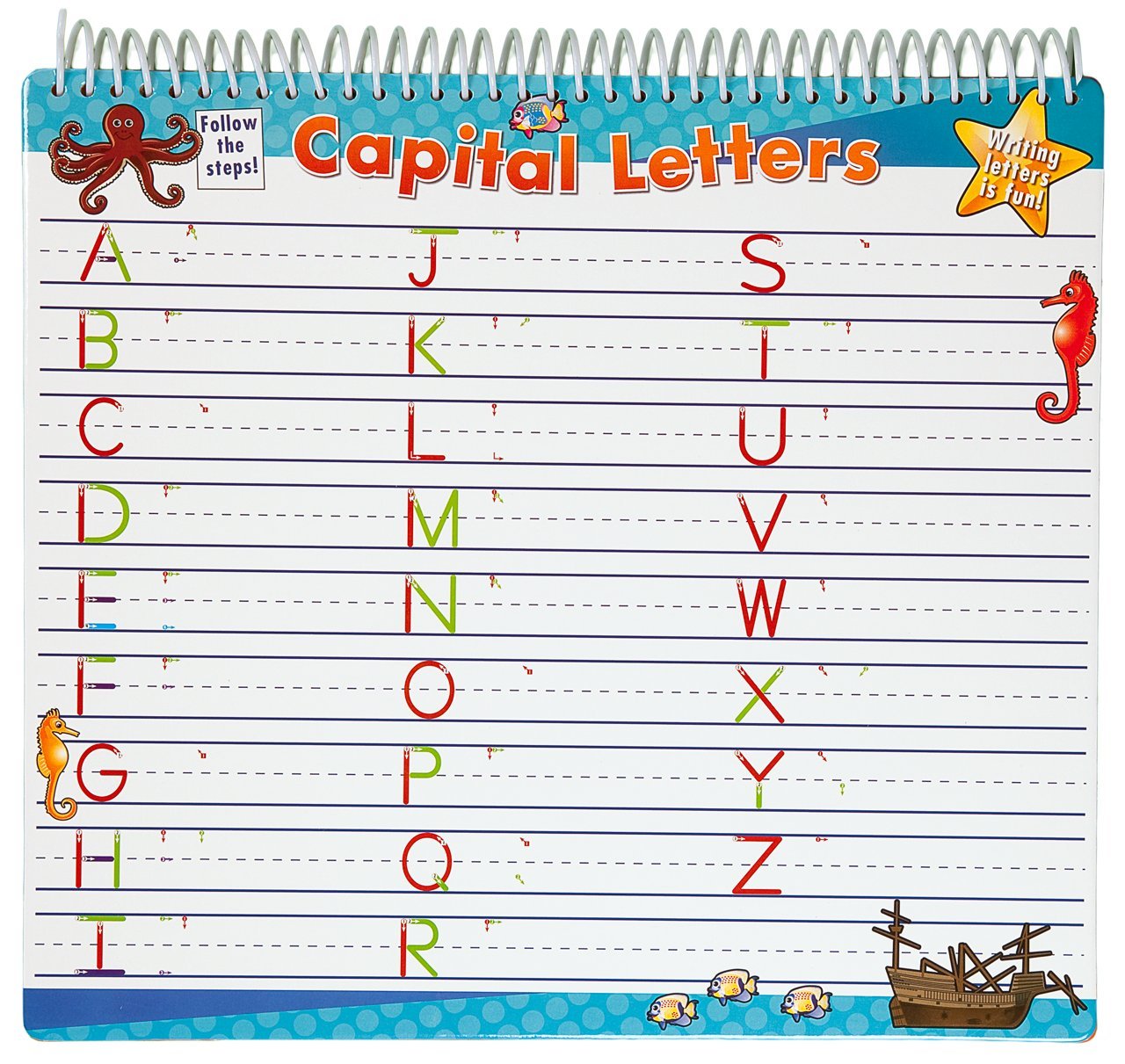
You can use any small whiteboard but I had one of these flip-style activity boards.  There is also a smaller version that I found at a dollar store.


Word-searches – printable word-searches, highlighter
You can print very simple word-searches that even non-readers can do. Kids at this age think highlighters are amazing.


Thursday, January 23, 2014

Homeschooling - centers for the younger ones

I like to say that we arrived late to the homeschool party. My kids were in 7th, 5th, and 3rd grades when we started. The upside to that was my kids could all read, write, and do basic math – this was going to be a breeze.

Enter child number four. We adopted a 5 year old that was half way through kindergarten when he came to live with us. We decided to homeschool him with the rest of our children; so with no time to prepare, I began teaching a kindergartener that did not know how to read, write, or do basic math. He was already a little behind his classmates. He also needed a lot of attention which made schooling the other children more difficult.

Enter “center time.” I created as many “centers” (I use this term loosely) as I could think of to keep him busy and productive. We had a small house, so “centers” needed to be compact and portable. I bought several clear plastic shoe boxes at the craft store for less than a buck each. I labeled the outside of each box with a picture icon of the “center.” Then each morning, he would choose 4 or 5 “centers” that he would do for the day. Most of them could be done independently once he understood what to do, though a few of them required a partner (mom or an older sibling).

For kindergarten our day consisted of centers, reading together, computer time, and joining in with the older siblings for unit studies. He needed speech therapy; so we worked on that each day as well. On Fridays we went to a co-op. We kept it simple. He learned to read and write and do basic math (though he still struggles with math). My advice is this – don't stress, keep it simple, they will learn.

Most of these ideas could be used from preschool through first grade depending on the child. I modified them some between kindergarten and first grade, so I will list all of the ones we used over the years. Most of them use things you probably already have around the house and whatever you do need to purchase will not cost much.

Today I will cover some general centers. Future posts will cover math and language arts centers.
I have written about sensory bins before and they would also make great centers.

Mail center – all of your junk mail especially the postcard type, rubber stamps, stickers
I learned this game as a kid from my best friend's mom. We would play mailroom for hours. Let your kids stamp and sticker the mail. You could even make a mailbox out of an old shoebox with a slot on top.

 Flashcards (Flashcard race) – flashcards: alphabet, sightwords, numbers, addition, etc.; board from a boardgame (I like the Balderdash game board) and 2 board pieces
Flashcards are great for many centers and learning in general.  You can find them online to print for free or buy them at a dollar store.  We play a game with them, too. Find a very basic board from any board game, or create your own with around 20 spaces from start to finish. Show your child a flashcard and if they get it correct they get to move one space. If they do not get it right, you move one space. Obviously, I always let him win by making sure he knew more of the cards than he did not know – but it is a fun way to challenge him and keep it interesting.

Sewing or Lacing Cards – cards and laces or yarn (I bought some at a yard sale and some at a dollar store. You can also make them.)
This is great for fine motor skills.


Games – pickup sticks, connect four, memory,yahtzee,  tiddly winks
This changed from time to time based on interest and skill level. You might be surprised how many games can be “played” independently even if they weren't designed to be. Connect four is great for making patterns. Candyland and Chutes & Ladders are sometimes more fun without the pressure to win – the goal is just to finish.

Puzzles – 24 to 48 piece puzzles (tons of choices at a dollar store)

Science box – magnifying glass, small measuring tape, plastic tweezers, nature books 
Encourage your child to explore (inside and outside) by examining, measuring, and even collecting whatever they find.

Magnets – magnet set or gather magnets and random items to “test”
If you have a magnet set, kids can build things with them. Otherwise, collect some magnets (kitchen magnets will do) and random things for them to test out if they are magnetic or not.  Make sure your child does not put things in his mouth before starting this one.

Blocks – depending on age: Duplo, Lego, Trio, or whatever you have (Lincoln Logs, anyone?)
My son doesn't really like to play with toys, so making it a center was important for us. If you have a kid that builds with blocks for hours just for fun – skip this one.


Art box - water colors & paper, paint with water books, paintbrushes, finger paints (if you dare), newspaper (to cover the table)
Let's face it; kids love this stuff.

Playdough - playdough (store bought or homemade), cutters and tools
If you are like most parents, you have too much of this stuff.  The key here is to put just enough to fit in the small plastic shoebox, then rotate the contents from time to time.


Other ideas would be puppets, a play kitchen area, coloring, a book center where they can "read", books on CD, musical instruments (if you can stand the noise), and any educational toys you already have.  Go on a hunt through your home to find things that could be put to use in a "center."  You'll be surprised at what you can come up with it.


Saturday, January 18, 2014

Homeschooling - free online resources

Homeschooling is not always a choice that is good for your budget! It is very easy to get carried away with purchasing curriculum, manipulatives, supplies, and every little neat thing you come across. So in an effort to help you keep costs down, I am going to write a series of posts devoted to low cost homeschooling. This post is about my favorite websites and is full of links to free online resources.

  
Some of my favorite websites for the kids:

Starfall is for the preschool and kindergarten set. It teaches letters, phonics, and reading. It combines videos, games, and interactive stories to teach children how to read.

ABCya is for elementary students from Kindergarten through fifth grade and is separated by grade level. It has educational games for math, English, typing skills, and geography, as well as purely fun and holiday themed games.

Sheppard software has learning games for preschool through high school. The subject matter includes everything from colors and animals to math, science, geography, history, and language arts.

Book Adventure is a book reading program.  Your child reads a book then takes a quiz on it (you can check if a book has a corresponding quiz first).  If they do well they earn points toward prizes they can redeem.

GA Virtual Learning is for middle school and high school students. It is a free resource from Georgia public schools. They have complete courses in every subject you can imagine. The courses include videos, power point presentations, games, quizzes, writing assignments, and more. The parent would be responsible for all grading – this is a resource not an online school.

Some of my favorite websites for the parents:

Homeschool Skedtrack is a program to keep track of attendance, assignments, and grades. For older children, you can give them a login so they can keep up with their own assignments. This has been a life-saver for me! I am very type-A, so this helps me, but if you are not type-A it may stress you out.

Evernote is not a homeschool site but it can revolutionize the way you keep track of online resources, pdfs, and anything else on your computer or the web that you want to remember and organize.

Free Homeschool Deals is a great way to snag free ebooks, curriculum, and more. I always go ahead and download anything that looks promising while it's free, even if I'm not sure I will use it. A few extra pdfs on my computer (or in my Evernote) are not taking up valuable shelf space, but may come in handy later.

Easy Peasy All-in-one Homeschool is a blog of one family's curriculum. I have never used her actual plan for each day but she has done a lot of research to list online resources. She has it organized by grade level and subject – be sure to take a look at the music and art classes.

ABC Teach has free worksheets for preschool through high school for every subject. Not all of the worksheets are free but many are and it is easy to sort by which ones are free.  You do not have be a member to print the free worksheets.  Some of my favorites are the book report forms.

Homeschool Share is great for lapbooks and unit studies. I also like Confessions of a Homeschooler.

Do NOT buy curriculum for kindergarten. There are so many free worksheets out there. Try Kids LearningStation, edHelper, or kindergarten worksheets.

For learning fun tailored to what you are studying, try a word search generator from edHelper, armored penguin, or ABCya (which also has a junior version for simpler ones).

Math worksheets are great for drills and review. There are too many out there to list but try these: homeschool math, math drills, or math-u-see.

I could fill many more pages of the amazing resources that are available out there for free (and maybe one day I will).  Hopefully, this gets you started on homeschooling on a budget.


Tuesday, July 23, 2013

Adoption is affordable - Part 3

So you've decided that you want to adopt, and maybe foster care is not what you are thinking.  That's ok - adoption can still be affordable.  You just have to get creative!

Individual families raise funds in a variety of ways - from bake sales to sporting events and everything in between.  This list of ideas can help you get started.

There are ways to fund raise online, such as gofundme which allows you to set a goal, tell your story, and collect funds.  It is also possible to raise funds on your own blog using pay pal.

Then there is Give 1 Save 1 which is a blog that challenges its followers to give $1 each week to their chosen family of the week in order to help bring another orphan home.  Recently, someone I know was the family of the week on Give 1 Save 1 where their story was shared and people were linked to their adoption blog to donate.

Many organizations help fund adoptions through grants and fundraising - some organizations raise money for families and some raise money for specific orphans.  Here are just a few.
Show Hope gives grants to families for adoption.
Lifesong for Orphans provides matching grants and no-interest loans to families for adoption. 
Reece's Rainbow raises funds for the adoption of specific children with Down Syndrome.
Love Without Boundaries raises funds for the adoption of specific children from China.
And there are so many more!  This list can help you find the right organization for your adoption journey.

There is also an adoption tax credit: a specific amount that can be deducted from your tax liability.  The amount changes every year and cannot exceed your actual expenses.  Also, it is not a refund; it is a deduction.

Be encouraged.  If you desire to adopt, it can be a reality!

If adoption is not something you are called to, maybe you can help donate to someone who is called.  Together we can care for the orphans.


Monday, July 22, 2013

Family fun

I learned about sensory bins here and decided to try them out.  I made very simplified versions of the Doc McStuffins one and the dinosaur one.  I made them for my 7 year old, but my husband and 10 year old had tons of fun playing with the dinosaurs.  I used an old plastic container, a bag of split peas I had on hand, and a bag of dinosaurs I bought for $1.  Totally worth it!  I will be trying out more of these in the future.


Coloring night at our house was also a success.  We were all bored.  There was nothing to do.  Well nothing that we could think of that was free and not outside in the heat.  So we broke out the coloring books, crayons, markers, and colored pencils.  We spent hours coloring together and listening to music.  It was an amazing night of free family fun.


Monday, July 15, 2013

Adoption is affordable - Part 2

(Adoption is such a complex issue.  This installment will focus on the adoption of older children.  My words are meant to inspire and encourage, never to guilt.)

I have had several conversations lately with people who are older (meaning they are beyond child-bearing age and/or are empty-nesters) who have expressed a desire to adopt but feel like it is too late for them.  On the contrary, it may be the perfect time to adopt.  Sure, you don't want to have a baby when you turn 50, but how about a teenager?  Older children are less likely to be adopted.  In fact, one of the "special needs" children have is being a teenager.  Yep, you read that right.  Just being an older child causes the likelihood of adoption to drop and therefore earn the label "special needs".

They still deserve a forever family.  Can you imagine your life from age 18 on with no one to call family?  No where to go for holidays; no father to walk you down the aisle; no grandparents for your children?  Yet that is precisely what happens when children age-out of the foster care system.  They turn 18 (age varies by state) and find that they have no family and often no where to go.  In 2011, approximately 40,000 children were emancipated.  Emancipation - an ironic term that sounds like freedom but freedom from what?  Freedom from love and security?

What does this have to do with adoption being affordable?  I think many people may hesitate to adopt an older child at least partly due to financial concerns.  Not only the anticipated cost of an adoption, but also the costs associated with caring for a child.  A child that will soon drive, and go to college, and get married, and ... we may start to see $$$.

Here are some little known facts about how the foster care system wants to HELP you adopt.
1.  Adoption Assistance - Some children qualify for adoption assistance, which is a set amount of money that you receive each month to help cover the costs of caring for the child.  The amount varies greatly based on factors such as age, medical needs and other special needs.
2.  Health Insurance - Most children will qualify for Medicaid until they turn 18 even after they are adopted.  This means free health care, such as doctor visits and prescriptions.
3.  College Tuition - Some states (including mine) have amazing college tuition funding for older children that are adopted from foster care (typically those over 12).

With 104,000 children in the U.S. foster care system currently waiting to be adopted, it's time we dispel the common myths about adoption from foster care.  If you have ever thought about adoption but have questions or hesitations, feel free to comment or contact me directly - I'd love to hear from you.


Monday, July 8, 2013

Summer boredom busters


There are two words that I cannot stand to hear; "I'm bored."

For some reason summer seems to bring boredom.  Who knew that my kids really loved school?  Right?  We are so blessed with so many things that honestly I get upset when kids say they are bored.  You have a room full of toys?  Sports equipment in the garage?  Shelves full of books?  You have more than most kids in the world could ever dream of.  Yet, I think my kids really just lack some imagination or direction in what to do with their time. 

So, last summer I came up with an idea.  What if I made a list of all the possible things they could do that don't cost money?  Then they could look at it and make a choice for themselves rather than expecting me to be the cruise ship director of their summer fun.  I made a list on our chalkboard and added to it throughout the summer.  In fact, I told them that if they uttered those dreadful two words I would have only one conclusion to draw - they must have done everything on the board and obviously need more chores.

I have to say it worked fairly well.  The kids caught on quickly and I think in the end they had more fun than even I anticipated.  With our family moving this summer, I almost forgot about the boredom board.  I think it's about time to get started again.

Friday, July 5, 2013

Adoption is affordable - Part 1

(This post has been weeks, maybe even months, in the making.  I have so much to say on this topic that it will be posted in installments.)

When we first adopted our youngest son, I was amazed at how many people mentioned their own desire to adopt.  Yet, without fail almost every person voiced the same concern.  "We really want to adopt, but it's just too expensive."  I want to dispel the myth that adoption has to be expensive.  Obviously, if we can do it - so can you!

Private infant adoption and international adoption can be costly.  We chose to adopt through the foster care system.  Staying local cuts obvious costs like flights and hotels, as well as other costs involved such as international fees and visas.  The main cost difference between private and foster care adoption is that the government pays most of the fees associated with adoption through foster care.

That doesn't mean it is free, but it is significantly less expensive.  All adoptions start with the same costs - a home study.  The home study will involve background checks, finger printing, home fire safety inspection, CPR/First Aid training, and possible other small costs.  There are many factors but you should estimate about $1,000 to cover all of the costs.  Once your home study is finished there are few if any costs involved in an adoption through foster care.

However, cost is only one of many considerations when adopting.  I think there is a stigma in adopting from foster care.  I have heard things such as: "Aren't they all special needs?"  "Don't they all have problems?"  "I heard you can only adopt teenagers."  I'm sure most people are well-meaning, but honestly my biological children have problems and one has a learning disability.  That doesn't mean anything to me.  A child in foster care has obviously had a disadvantage in life - they have experienced great loss at an early age.  This is true in every adoption story.

The subject of age is another matter.  It is true that adopting an infant from foster care is unlikely.  That is because the system of foster care is always hoping for reunification.  By the time it is obvious that reunification is impossible, most children are older.  There are times when parents willingly relinquish an infant, but more often than not legally free (adoptable) children are already over the age of 4.

My husband was so over diapers and potty training and  sleepless nights that a 4-year-old sounded just about right.  Our youngest was 8 at the time, so we wanted a child under 8.  No problem, within six weeks of finishing all of the paperwork we were told that a special little 5-year-old would be our son.  Every story and situation is different, but if you are not pursuing adoption because of the cost, be encouraged.  Adoption is affordable!!

Monday, June 24, 2013

Up-cycled table

I've been looking for a small table to put on our back porch.  I tried yard sales and Craigslist but nothing seemed right.  Finally, my husband went to the Restore and found something acceptable.  I say acceptable because it was plain and ordinary - nothing much to look at.  But it only cost $15, so we went with it.


Something had to be done to liven up the table.  Our kids like to play games on the porch, so why not a game table?  I measured out a checkerboard on the top and taped it off.  I considered a traditional red/black color scheme but we don't have any red paint.  I considered going with black and the natural table, but that seemed boring.  I had some blue paint (I have no idea where it came from!) so I decided on blue and the natural table.  After painting and removing the tape, I applied three coats of polyurethane.  Now the kids can play checkers, chess, or even just a game of cards.

Sunday, June 23, 2013

Free stuff for the summer

I have four kids, so doing fun things can get really expensive.  Here are some of our favorite free (or super cheap) things to do in the summer.

$1 movies - Regal or Cinemark (or Carmike but this costs $4 and includes popcorn and a drink)
G and PG rated movies that are not new releases are shown on weekday mornings.
We have found that sometimes restaurants next to the theater will offer lunch specials on those days.

Free bowling - AMF or various others
Kids can bowl two free games every day.  The cost of shoe rental is not included and can vary from place to place, so call ahead to find the cheapest one near you.

Free skating - various
Unfortunately there is not one near me - but maybe you will be lucky!

Free museums
There are a lot of these near me and we frequent them year round.
Also, if you are a customer of Bank of America or Merrill Lynch you can participate in Museums on Us.

Of course don't forget parks - local, state, and national.  These can provide everything from swimming, hiking, and camping to educational and historical field trips for little to no cash.

Enjoy your summer!